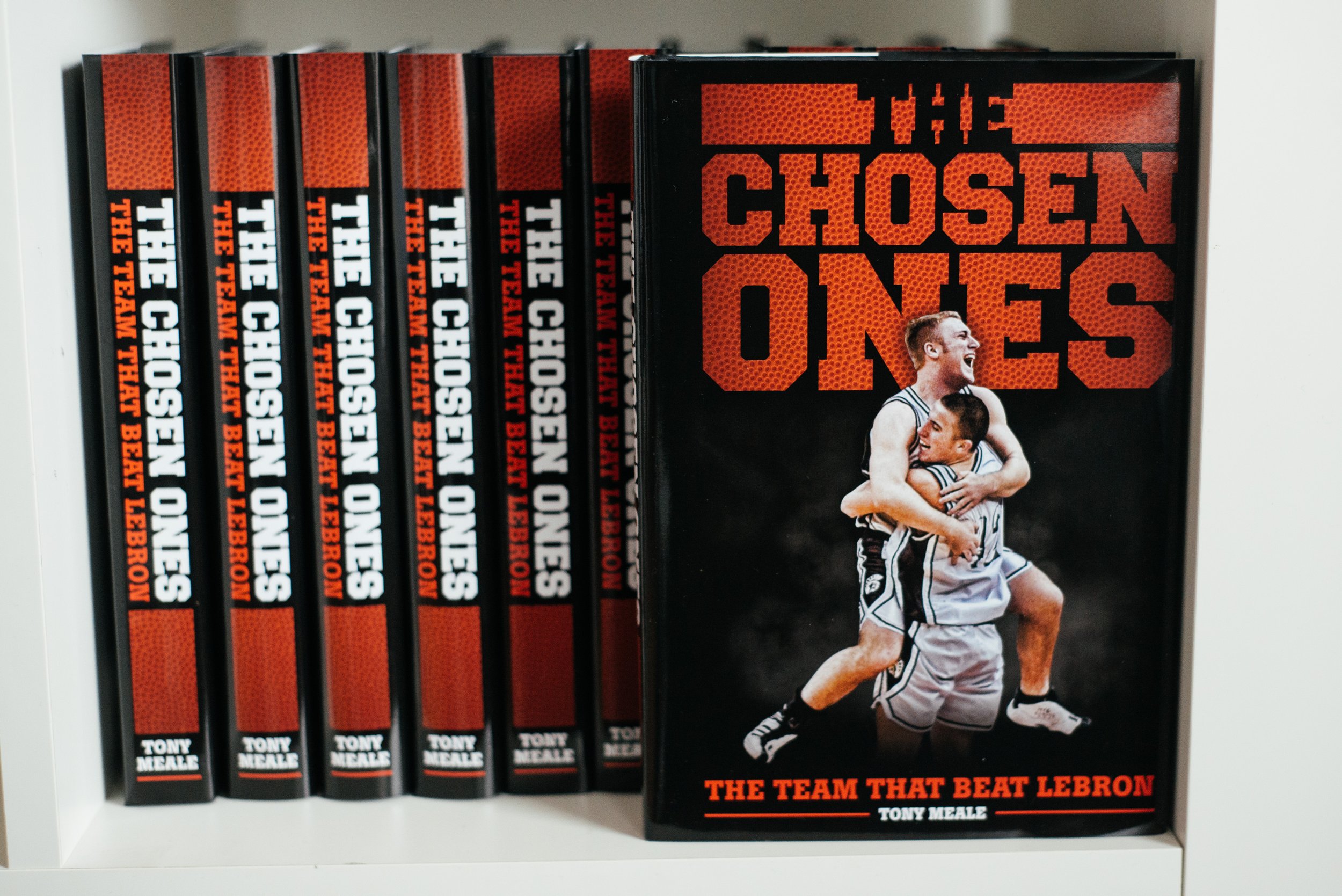
“The Chosen Ones:
The Team That Beat LeBron”
AN INSPIRING TALE OF A TEAM THAT DARED TO DREAM
AND A COACH WHO REFUSED TO LET THEM FAIL
In February 2002, high school junior and two-time state champion LeBron James, an Ohio wonder on the cusp of national stardom, appeared on the cover of Sports Illustrated with the words “The Chosen One.”
And yet, a coach and his team of relative unknowns at Roger Bacon, a Catholic high school in Cincinnati, didn't seem to notice. One month later, Roger Bacon faced James and seemingly invincible Akron St. Vincent-St. Mary in perhaps the most highly anticipated state final in Ohio history.
Basketball would never be the same again.
“The Chosen Ones: The Team That Beat LeBron” tells the untold story of struggle and triumph, of setback and success, of tragedy and redemption of the only Ohio prep basketball team to ever beat LeBron James. The 372-page book reveals how a group of young men, driven by their coach, forged a brotherhood and fearlessness that produced one of the most inspiring underdog stories the sports world has ever witnessed.
Book Reviews
"March 23, 2002, was a huge moment in the career of LeBron James. He has told me it was one of the toughest losses of his life and something that ended up changing the way he looked at the game and respected his opponents. Everyone who plays in a championship game on any level will always have the memory, but it doesn’t always change the lives of the participants. Roger Bacon’s amazing win over St. Vincent-St. Mary did change lives. What it did to LeBron and his teammates became a movie. What it means to the Spartans is detailed wonderfully by Tony Meale in this book. Tony . . . was fascinated by their accomplishment and how it had taken place. You will be, too.”
– BRIAN WINDHORST, ESPN.com NBA writer and the author of “The Franchise: The Remaking of the Cleveland Cavaliers” and “LeBron James: The Making of an MVP”
"This is Hoosiers meets Remember the Titans – one of the best reads I’ve had in a long time. We know what became of LeBron; ‘The Chosen Ones’ tells us what became of the team that beat him in what was one of the most unlikely – and unexpected – outcomes in the history of American high school sports.”
– JOHN ERARDI, Cincinnati Enquirer sportswriter and author of “The Wire-to-Wire Reds: Sweet Lou, Nasty Boys and the Wild Run to a World Championship”
"If journalism is literature in a hurry, ‘The Chosen Ones’ is literature worth the wait. Those of us who watched Roger Bacon’s improbable upset of LeBron James . . . knew the magic of that moment did not materialize all at once. It was the product of a demanding coach and his driven players. Tony Meale has told their story with such a keen eye and with such intimate detail that the stunning result has finally started to make sense.”
– TIM SULLIVAN, Louisville Courier-Journal sports columnist
"If the LeBron James-St. Vincent-St. Mary angle isn't enough to draw you in, the collective hope, passion and family-like attributes of the Roger Bacon story should finish the job. It's a story about basketball, sure. But it's one that any sports fan can relate to – it's about loss, about gain, about togetherness, motivation, and, most importantly, triumph against all odds."
– SCOTT SARGENT, Waiting For Next Year
"This is the ultimate ‘Nobody believed in us’ story, and it is told eloquently. There are moments of joy, tragedy, overcoming impossible odds and even mortality. . . . The Roger Bacon Spartans are a team whose legacy is beating LeBron James. There is so much more to the story, and this book immortalizes it for basketball fans. Whether you love or hate LeBron James, this is a fascinating look at a team whose sum was greater than all of the parts. ‘The Chosen Ones’ is Tony Meale's first book, and if it is any indication, he will have many more to come."
– DEMETRI INEMBOLIDIS, The Cleveland Fan
"Meale’s extensive reporting helps bring the personalities at the center of the story to life, and his detailed re-creations of those Bacon-St. V games are compelling. LeBron's stunning high school career changed a lot of things about American sports; the last game of his junior year forever changed the lives of a bunch of no-name kids from Cincinnati. Their story is worth a read.”
– RYAN JONES, former SLAM Magazine editor in chief and the author of “King James: Believe the Hype – The LeBron James Story”
"Fantastic read. (This) is so much more than just a book about a team that won a state title. Tony does a fantastic job detailing the emotion, heartbreak and triumph of a magical season."
– LANCE MCALISTER, ESPN 1530 Radio Host
“Tony Meale’s ‘The Chosen Ones’ is a thorough and entertaining delve into that season, those players and their late coach, Bill Brewer, who died way too soon. Meale’s book shows the transcendent power of big, young dreams.”
– PAUL DAUGHERTY, Cincinnati Enquirer sports columnist and author of “An Uncomplicated Life: A Father’s Memoir of His Exceptional Daughter”
“This, I guess, is as good a reason as any for doing what we do. People are born, and they die, and those who remember them die too, and the place where they keep living is in our stories, written down, printed on a page, shielded between hard covers, collected on the shelf, available as long as the paper holds together. We were here, those stories say, and for a moment or two we were great.”
– THOMAS LAKE, former Sports Illustrated senior writer and author of “Unprecedented: The Election That Changed Everything”
EXCERPT FROM “The Chosen Ones: The Team That Beat LeBron”
Preface
© Tony Meale
Me and LeBron James got a lot in common. We’re both from Ohio, we both love basketball and we both graduated high school in 2003 from schools that begin with the word St. Those aren’t the only similarities, mind you, but those are some that most readily come to mind.
The truth is, I’ve always been fascinated by LeBron James. Like a lot of Ohio high school boys in the early 2000s, I knew who LeBron was and began following his career when he was still merely a statewide wonder—as opposed to the global icon he has become. He wasn’t the only can’t-miss prospect I came across in high school (as a Cincinnati native, I began following O.J. Mayo when he was in junior high), but something about LeBron was different. Maybe it was the name itself. LeBron. There was something majestic about it, something magical. There still is. But even at the turn of the century, I knew he was special. I knew he was once-in-a-generation.
Technically speaking, LeBron, not even six months my senior, is my peer. But it never felt that way. Cliché as it sounds, LeBron always seemed larger than life to me—and not just because he’s a foot taller. When LeBron was a junior in high school, he was well on his way to becoming a national obsession; when I was a junior in high school, I was well on my way to the prom. While I daydreamed of writing for Sports Illustrated, LeBron was on the cover. He could dunk seemingly from the free-throw line, whereas I could barely touch net. Things that seemed impossible for me seemed effortless for LeBron.
Maybe that’s where the fascination came from.
High school sports are a big deal in Ohio, especially Cincinnati. In Cincinnati, they are a religion. They are something by which people identify themselves—and each other. Where you went to high school is as much a part of you as who you marry and what you do for a living. Good or bad, for better or for worse, that’s the deal. No one questions it. Not locals, anyway.
Thus, most of my Friday nights in high school were spent in a stadium or a gym. Every basketball season, my school played a league rival named Roger Bacon. It didn’t matter that my school was Division I and Roger Bacon was Division II; the Spartans always played us tough and, perhaps surprising to some (even me, at first), won with unfailing regularity. Some Division II teams, when facing a team from Division I, get scared; they get flustered. Not Roger Bacon. With Roger Bacon, there was never intimidation; there was never backing down. Win or lose, regardless of talent, the Spartans always played hard. They always played scrappy. They never quit.
By the time I was a junior in 2001-02, I had come to expect this from Bacon. I wasn’t surprised when the Spartans beat us that year, nor was I surprised when they kept advancing in the postseason tournament. But all along I knew what awaited them: LeBron James and Akron St. Vincent–St. Mary. And that’s exactly what happened. I read a game preview the day of the state final, fully expecting a slaughter. Rooting for Bacon to win never even crossed my mind; I was simply hoping for a close game.
And then I went on with my Saturday.
The next day—March 24, 2002—I opened the Sunday edition of the Cincinnati Enquirer (for this was a time when people still learned of news via newspaper) and discovered that Bacon, somehow, had won. I read the coverage, stunned, scores of thoughts meandering my mind.
Colossal misprint? Joke? Hoax?
But the 16-year-old in me realized those explanations were as unlikely as Bacon’s victory, and soon I kept thinking the same four words over and over again.
They actually did it.
Once the shock subsided, two thoughts crossed my mind: one, what Bacon had done was special, and two, it would be years before people—even those living in Cincinnati and throughout Ohio—understood just how special the accomplishment truly was. As it turned out, Roger Bacon was the first, last and only Ohio team to beat LeBron James between the lines during his four-year prep career; the fact that it occurred in the state final only made it that much more spectacular, if not improbable. In some circles, that game became known as “the Ohio version of Hoosiers,” which isn’t a bad analogy, but as I discovered, isn’t altogether perfect.
Ever since that state final, LeBron seemed more human to me. The fascination was still there, of course, but I became just as fascinated—if not more so—by the team that beat him. LeBron had always seemed otherworldly, untouchable—the exact opposite of Bacon. The Spartans weren’t once-in-a-generation players; they were guys from Cincinnati, guys my age, guys who attended a school not far from mine.
They were just like me.
As the years passed, I tucked away the brilliance of Bacon’s win. I got a degree, a master’s, and set off to make my mark in sports journalism. When it turned out the New York Yankees didn’t need a fresh-out-of-J-school beat writer, I ended up back, where else, in Cincinnati, covering, what else, high school sports. It was kind of fitting. High school sports had always been a part of me. After a few months, though, it became painfully obvious that while growing up, my view of prep sports had always been myopic; if the story wasn’t about my school, I was in many ways indifferent to it. But now I was covering schools that I had once rooted against or, quite frankly, had never even heard of. I told stories of prep athletes known only in this city who were of interest only to the communities in which they lived. There was no LeBron James among them. But in that time, I realized that every athlete has a story, that every school has pride, that high school sports truly are the heartbeat of this town.
And yet, something kept pulling me back to Bacon. Something kept tugging at me. The same questions I had always asked in passing now demanded answers. How did Bacon do what it did? What did the accomplishment mean then? What does it mean now? My curiosity became a thirst I couldn’t quench, an itch I couldn’t scratch—until finally I gave in. I decided that the story of that team, dormant for a decade, needed to be told.
So I set about telling it.
I sent emails. I made phone calls. One interview became 10. Ten became 50. Hundreds of hours of interviews later, after talking to almost every member of that team and coaching staff, among others, I had it—I had the tale of the only high school basketball team in Ohio history to beat LeBron James.
What follows, as you may have gathered, is not an eye-witness account. I was not among the 18,375 people in attendance at that state final. I was not privy to the practices about which you will read. I knew none of Bacon’s players personally. Aside from newspaper stories and box scores, I relied almost exclusively on the memories—dating back five, 10, even 25 years in some cases—of people on, or close to, the 2001-02 Roger Bacon basketball team. In addition to a handful of group interviews, I spoke with almost everyone one-on-one at least once. I listened as former players and coaches told their story and the story of that team and that season. There were times when the same anecdotes were recalled by different people in different settings. Memories, by and large, aligned. Peripheral details weren’t always identical, but the basic story remained. Almost every interview request, large or small, was accommodated—the one notable exception being LeBron James, whose representatives respectfully declined on his behalf.
So, no, this is not an eye-witness account. But I wish it had been. I wish I could have been at those practices. I wish I could have been in those locker rooms for those postgame speeches. I wish, maybe most of all, that I could have met Bill Brewer, that I could have known him.
Sure, I learned things about LeBron that I didn’t know. I gained insight into who he was in high school and how that has affected who he is in the NBA. But I learned, above all else, that there’s a little Roger Bacon in all of us, that the players and coaches on that team were not special in any way, and yet, they were.
Yes, this book is about Roger Bacon. Yes, it is about basketball. But it is first and foremost about the human spirit. It is about any team, any person, any underdog who dares to dream and who, in the face of setback and sorrow and immeasurable odds, chooses to so valiantly and so doggedly chase greatness.